
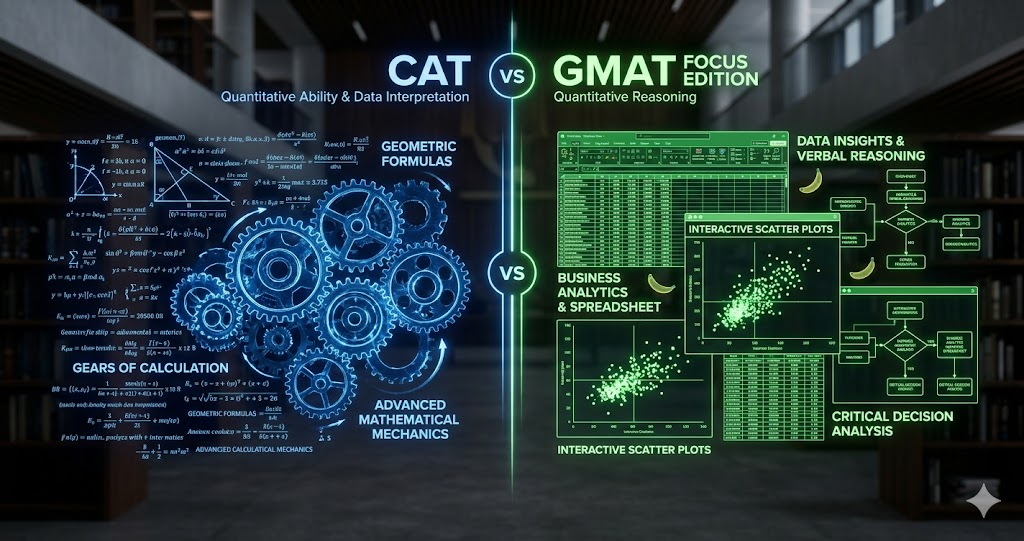
For Indian applicants targeting top-tier business schools, the choice between the Common Admission Test (CAT) and the newly formatted GMAT Focus Edition is the most critical strategic decision of their MBA journey. While the CAT remains the gatekeeper to the IIMs, the GMAT Focus has aggressively streamlined its format to appeal to data-driven professionals.
Based on our proprietary adaptive testing data at MBAPrep.pro, here is a definitive, section-by-section breakdown of how these two exams compare, and which one yields the highest Return on Investment (ROI) for your specific career goals.
1. Structural & Algorithmic Differences
The fundamental difference lies in how the tests measure your ability. The CAT is a linear, high-pressure sprint against the clock. The GMAT Focus is a Computer Adaptive Test (CAT) where the difficulty of the next question changes based on your real-time performance.
| Feature | CAT 2026 | GMAT Focus Edition |
|---|---|---|
| Duration | 2 Hours (Strict 40-min sections) | 2 Hours 15 Mins (Flexible order) |
| Algorithm | Linear (All questions predetermined) | Question-Level Adaptive |
| Question Count | 66 Questions | 64 Questions |
| Calculator | On-screen calculator for Quant | Allowed ONLY on Data Insights |
2. Quantitative Difficulty: Math vs. Logic
There is a massive misconception that because Indian engineers excel at math, they will naturally ace the GMAT Quant. The reality is that the two exams test entirely different quantitative muscles.
- CAT Quantitative Ability (QA): Tests mathematical depth. You need to know complex theorems across Geometry, Higher Algebra, and modern math. It rewards raw computational speed and formula memorization.
- GMAT Focus Quant: Tests executive logic. Geometry has been entirely removed. The syllabus is limited to basic Arithmetic and Algebra, but the questions are designed as intellectual traps. It rewards catching edge-cases (like testing zero, negative fractions, or primes) over raw calculation.
3. Verbal & Data Interpretation Differences
The removal of Sentence Correction from the GMAT Focus has leveled the playing field, making both exams heavily reliant on Reading Comprehension.
- CAT VARC & DILR: CAT Reading Comprehension features dense, philosophical, and abstract passages. The DILR (Data Interpretation & Logical Reasoning) section is notoriously grueling, often requiring you to build complex multi-variable matrices from scratch.
- GMAT Focus Verbal & DI: GMAT RC is much more structured, testing the logical flow of arguments rather than abstract vocabulary. Instead of pure puzzles, the new Data Insights (DI) section tests real-world data fluency: sorting spreadsheets, analyzing multi-tab emails, and evaluating charts.
4. ROI & Admissions: IIMs vs. Global/ISB
Your choice of exam should ultimately reverse-engineer your target career outcome. Here is the strategic admissions breakdown:
| Admissions Goal | Optimal Exam Choice | Why? |
|---|---|---|
| IIM A, B, C (Flagship 2-Year) | CAT | Only the CAT is accepted for domestic Indian students applying to the flagship 2-year PGP programs. |
| ISB, SPJIMR, Great Lakes | GMAT Focus | These top-tier Indian programs highly value the GMAT, and the applicant pool is slightly less saturated than the 3.3 lakh+ CAT takers. |
| IIM 1-Year Executive (EPGP) | GMAT Focus | If you have 4+ years of work experience, the GMAT is the required gateway to the prestigious 1-year IIM programs. |
The Verdict
If you are a fresh graduate aiming exclusively for a 2-year IIM program, the CAT is your only path. However, if you have work experience, struggle with complex Geometry/abstract puzzles, or want to keep international doors (and ISB) open, the GMAT Focus offers a significantly higher ROI for your prep time.
Regardless of which path you choose, MBAPrep.pro's adaptive LMS provides dedicated, algorithmic curricula for both exams. Stop studying blindly—let our data-driven platform pinpoint exactly what you need to focus on today.